Salary vs Dividends 2026/27: What’s the Most Tax-Efficient Way to Pay Yourself as a Company Director?
If you run an owner-managed limited company, “salary or dividends?” is never just a preference — it is a design choice that touches Corporation Tax, National Insurance, Income Tax, pension credit, and whether you still have distributable reserves to pay a dividend at all.

This guide is for directors who want a clear 2026/27 picture: what the confirmed HMRC thresholds are, w HMRC watch: National Insurance and dividends guidance.
hy a single “magic salary” is usually the wrong answer, and how total tax (company plus personal) changes under realistic scenarios. Figures are for the tax year 6 April 2026 to 5 April 2027, with income tax examples using England / Northern Ireland / Wales bands unless flagged. Scottish taxpayers use different salary bands — see the note below.
We work with ambitious owner-managed businesses every week on this exact trade-off. Nothing here is a ranking promise or personal advice; your optimum depends on profits, other income, Employment Allowance eligibility, and cash needs. If you want numbers run on your accounts, talk to our accountancy services team.
Rates and thresholds in this article were checked against GOV.UK on 11 September 2026. Re-check the linked pages before you rely on any figure if HMRC has updated them.

Further reading: Who we help · Our accountancy services · Making Tax Digital for Income Tax
Key takeaway
So what salary should I actually take in 2026/27?
There is no single correct salary for every director. The right level depends on whether Employment Allowance is available, whether you need a National Insurance qualifying year, and how much other income you already have. Use the three paths below as planning starting points — then stress-test them against your profits and cash.
In our headline £80,000 profit worked example (sole director, no Employment Allowance), a £12,570 salary plus dividends produced £55,765 cash to the director and £24,235 total tax — ahead of £5,000, £6,708, and £20,000 in that scenario. That result is scenario-specific, not a universal rule.
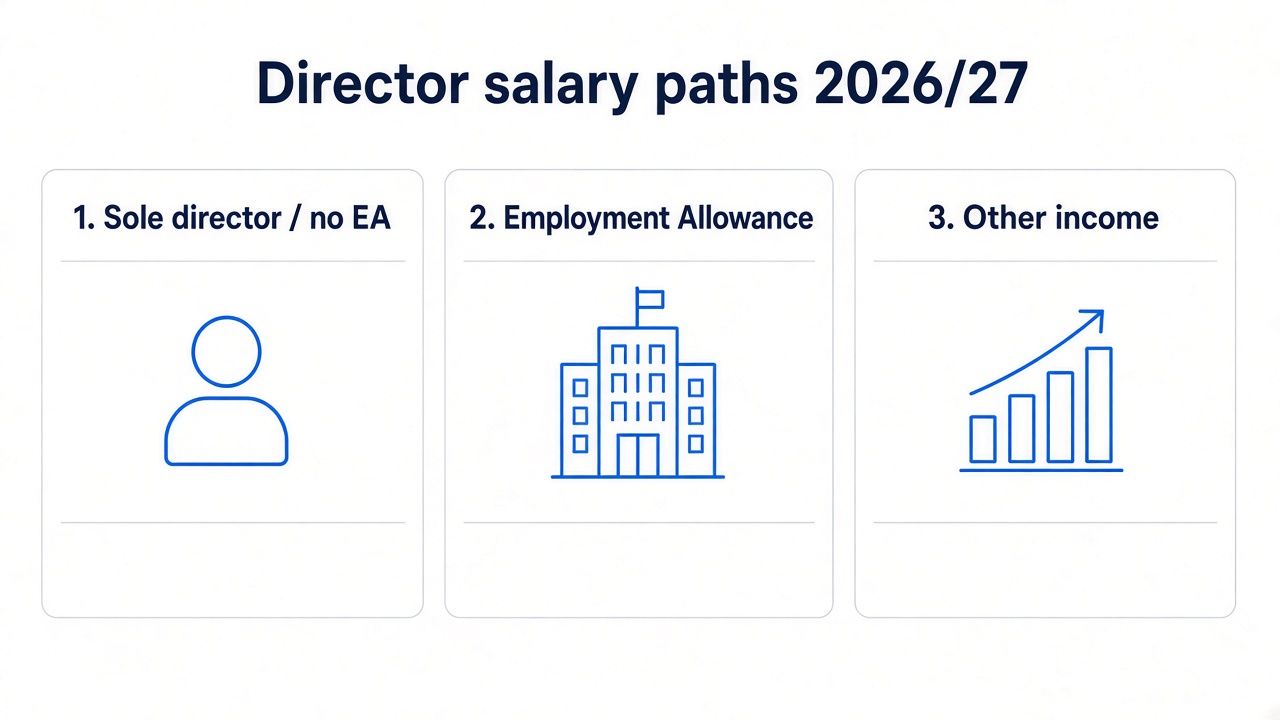
Three salary and dividend scenarios
1) Sole director / no Employment Allowance
Many one-person limited companies cannot claim Employment Allowance. HMRC’s rule is blunt: if the company has only one director and that director is the only employee liable for secondary Class 1 National Insurance, Employment Allowance is not available. That includes cases where other people are on the payroll but only the director is paid above the Secondary Threshold of £5,000.
In that world, employer NI at 15% on salary above £5,000 is a real cash cost. Against that, salary (and the employer NI you actually pay) generally reduces profits charged to Corporation Tax.
Practical guidance for 2026/27 (sole director, no EA, no large other income):
- Salary £5,000 (Secondary Threshold) — no employer NI. Watch-out: below the Lower Earnings Limit, so it may not protect a State Pension qualifying year from this employment.
- Salary £6,708 (Lower Earnings Limit) — aims at an NI qualifying year with no employee NI; modest employer NI (£256 in our worked example). Still pays 15% employer NI on the slice above £5,000.
- Salary £12,570 (Personal Allowance / Primary Threshold) — uses the Personal Allowance via salary; no employee NI; stronger CT deduction. Employer NI on £7,570 (£1,136) unless EA applies.
- Above £12,570 — only where commercial need, mortgage evidence, or other planning justifies it. Employee NI at 8% (then 2% above £50,270) plus more employer NI.

2) Company eligible for Employment Allowance
Employment Allowance for 2026/27 is up to £10,500 against employer Class 1 secondary NI. You may be eligible where, for example, more than one employee or director is paid above the Secondary Threshold (two directors both above £5,000; or a director plus an employee above £5,000).
When EA covers the employer NI on your chosen salary, the CT deduction from salary becomes much “cheaper” in cash terms.
Practical guidance where EA is available:
- A salary up to £12,570 is often the clean planning anchor: Personal Allowance used, no employee NI, and employer NI on that salary is typically fully offset by EA (gross employer NI on £12,570 is only £1,135.50 — well inside the £10,500 allowance).
- Pushing salary deeper into the basic-rate band (for example £20,000) can still be covered by EA on employer NI, but you then pay employee NI and Income Tax on the salary — which often loses to dividends for the slice above £12,570 (see Block B).
- Confirm eligibility every year. If circumstances change so the director is again the only person above the Secondary Threshold at the start of a tax year, stop the claim.
3) Director with substantial other income
If you already have meaningful employment, property, or sole-trade income, your Personal Allowance and basic-rate band may already be partly or fully used. Company salary then stacks on top — and dividends may be taxed at the higher dividend rates sooner.
Practical guidance:
- Do not assume a £12,570 company salary is still “tax-free”. Other income may already have consumed the Personal Allowance.
- A lower company salary at the Lower Earnings Limit (£6,708) can still be worth weighing if you need a qualifying year from the directorship and want to limit employer NI — but model the CT vs dividend-tax trade-off properly.
- Extra sole-trade or property income can also pull you into Making Tax Digital for Income Tax on that other income (company salary and dividends do not count toward MTD qualifying income).
Scottish taxpayers
Salary is taxed under Scottish bands and rates; dividend rates and the £500 dividend allowance remain UK-wide. National Insurance and Corporation Tax are also UK-wide. Re-run any optimum with Scottish salary tax before you copy an England example.
2026/27 rates directors actually need
Personal Allowance, bands, and the £100,000 taper
Personal Allowance: £12,570
Basic-rate band: £37,700 → higher-rate threshold £50,270 (with full Personal Allowance, England/NI/Wales)
Additional rate: income above £125,140
Taper: Personal Allowance falls by £1 for every £2 of adjusted net income above £100,000, down to £0 at £125,140
Once combined salary, dividends, and other income cross £100,000, the taper raises your effective marginal rate. Plan extractions with that cliff in view — not only the headline dividend percentages. See Income Tax rates and Personal Allowances.
National Insurance (Category A) — directors on an annual basis
Key 2026/27 annual thresholds (see Rates and thresholds for employers 2026 to 2027 and National Insurance for company directors):
- Lower Earnings Limit (LEL) £6,708 — floor often used for a State Pension qualifying year (earnings between LEL and Primary Threshold can count as NIC paid for benefit purposes).
- Secondary Threshold (ST) £5,000 — employer NI starts above this.
- Primary Threshold (PT) £12,570 — employee NI starts above this.
- Upper Earnings Limit (UEL) £50,270 — employee NI drops from 8% to 2% above this.
- Rates: Employee NI 8% between PT and UEL; 2% above UEL. Employer NI 15% on earnings above the ST (no upper limit for standard Category A).
Watch-out
Directors’ Class 1 NI is normally calculated on an annual earnings period. Weekly “LEL salary” shortcuts can fail if the annual total from that employment is below £6,708.
Dividend allowance
- Dividend allowance: £500
- Rates on dividends above the allowance (6 April 2026 – 5 April 2027): 10.75% basic / 35.75% higher / 39.35% additional (see Tax on dividends)
- Dividends within unused Personal Allowance are not taxed — but other income often uses the allowance first
- Dividend rates are UK-wide (including for Scottish taxpayers)
- Basic and higher dividend rates are 2 percentage points higher than 2025/26 — refresh any spreadsheet still using 8.75% / 33.75%.
Corporation Tax (financial year from 1 April 2026)
- Taxable profits £50,000 or less — 19% small profits rate
- Taxable profits above £250,000 — 25% main rate
- Between £50,000 and £250,000 — main rate less Marginal Relief (standard fraction 3/200) — see Corporation Tax rates and Marginal Relief for Corporation Tax
In the Marginal Relief band, the effective tax on the next £1 of profit is often illustrated at about 26.5%. That is a derived marginal effect from the 3/200 fraction, not a separate labelled statutory rate. Associated companies and short accounting periods reduce the £50k / £250,000 limits.
Interaction with pay:
- Salary + employer NI payable generally reduce taxable profits (wholly and exclusively / timing rules apply).
- Dividends are not a Corporation Tax deduction — they come from post-tax profits and need distributable reserves under company law.
- PAYE must run for salary. Dividends need proper minutes / resolutions and dividend vouchers / tax certificates.
Employment Allowance — amount and the single-director rule
- Allowance: up to £10,500 for 2026/27
- Single-director exclusion: limited companies cannot claim if they have just one director and that director is the only employee liable for secondary Class 1 NI (see Claim Employment Allowance — eligibility and Single-director companies and Employment Allowance guidance)
- When EA can unlock: more than one employee or director earns above the Secondary Threshold (for the whole tax year once that test is met)
Always confirm current eligibility on GOV.UK before building a plan around EA.
How the comparison works (method)
Every worked example below uses the same method so you can compare apples with apples:
- Start with profit before director salary and employer NI (and before any employer pension in the pension illustration).
- Pay the chosen salary; calculate employer NI at 15% above £5,000; apply Employment Allowance only where the scenario says the company is eligible.
- Deduct salary + employer NI actually payable for Corporation Tax.
- Charge CT at 19%, or main rate less Marginal Relief, or 25%, as appropriate.
- Pay the remaining post-CT profit as a dividend (full extraction).
- Calculate employee NI, Income Tax, and dividend tax (England/NI/Wales).
- Report cash extracted to the director (net) and total tax paid by company + director on that extraction.
Assumptions common to the examples: no associated companies; augmented profits equal taxable profits for Marginal Relief; distributable reserves equal post-CT profit; no student loan; no Gift Aid; Category A NI; director NI on an annual basis; figures rounded to the nearest pound (pennies retained in the companion calculator).
Example set A — £80,000 profit, sole director, no Employment Allowance
Assumptions: England taxpayer; no other income; not EA-eligible; full dividend extraction.
| Salary | Employer NI | CT | Dividend | Cash to director | Total tax | Winner? |
| £5,000 | £0 | £16,125 | £58,875 | £55,012 | £24,988 | |
| £6,708 (LEL) | £256 | £15,604 | £57,431 | £55,182 | £24,818 | |
| £12,570 (PT/PA) | £1,136 | £13,818 | £52,476 | £55,765 | £24,235 | Yes |
| £20,000 | £2,250 | £11,554 | £46,196 | £55,222 | £24,778 |
What this means
With profits in the Marginal Relief band, paying yourself up to the Personal Allowance can still win on both cash and total tax versus a pure “avoid employer NI” salary — because the CT deduction is valuable. Going to £20,000 added employee NI and Income Tax without improving the outcome.
A practical next step
Want this modelled on your profit and Employment Allowance position? Get a quote or call 020 3576 5278.
Example — £80,000 profit, Employment Allowance eligible
Assumptions: same profit and taxpayer profile; EA available and applied to this director’s employer NI (simplified).
| Salary | Employer NI | CT | Dividend | Cash to director | Total tax | Winner? |
| £5,000 | £0 | £16,125 | £58,875 | £55,012 | £24,988 | |
| £6,708 | £0 (EA offsets £256) | £15,672 | £57,620 | £55,303 | £24,697 | |
| £12,570 | £0 (EA offsets £1,136) | £14,119 | £53,311 | £56,301 | £23,699 | Yes |
| £20,000 | £0 (EA offsets £2,250) | £12,150 | £47,850 | £56,284 | £23,716 |
When EA fully offsets employer NI, CT is charged after deducting salary only (not NI). Rounded to nearest pound from companion calculator.
What this means
When EA wipes employer NI on a £12,570 salary, that level is the clear winner in this set. A £20,000 salary remains almost as good on cash but costs more personal tax/NI for negligible gain.
Example — £120,000 profit, sole director, no EA
| Salary | Employer NI | CT | Dividend | Cash to director | Total tax | Winner? |
| £6,708 | £256 | £26,204 | £86,831 | £74,072 | £45,928 | |
| £12,570 | £1,136 | £24,418 | £81,876 | £74,654 | £45,346 | Yes |
| £50,270 (fill BR band) | £6,790 | £12,929 | £50,011 | £71,968 | £48,032 |
What this means
Filling the basic-rate band entirely with salary is rarely efficient once employer NI is 15% from £5,000 and employee NI applies. Prefer salary for the allowance/threshold design, then dividends for the rest — subject to reserves and higher-rate dividend tax.
Example set D — £60,000 company profit plus £40,000 other income, sole director, no EA
Assumptions: £40,000 other non-dividend income (for example employment or property) already in the director’s personal tax computation; England; full extraction from the company.
| Salary | Employer NI | CT | Dividend | Cash to director | Total tax | Winner? |
| £0 | £0 | £12,150 | £47,850 | £33,365 | £26,635 | |
| £6,708 | £256 | £10,304 | £42,731 | £33,766 | £26,234 | |
| £12,570 | £1,136 | £8,796 | £37,499 | £33,868 | £26,132 | Yes* |
\*Edges ahead on company cash and extraction-path tax — but the Personal Allowance was consumed by the combined non-dividend income, so the salary was not “tax-free” in the everyday sense.
Watch-out
Model your own other income before copying anyone’s favourite number. If that other income is sole-trade or property turnover, check whether Making Tax Digital for Income Tax applies to it.
Example — £130,000 profit and the Personal Allowance taper
Full extraction here pushes adjusted net income through £100,000, so the Personal Allowance starts to taper.
| Salary | Employer NI | CT | Dividend | Cash to director | Total tax | Winner? |
| £12,570 | £1,136 | £27,068 | £89,226 | £78,973 | £51,027 | Yes |
| £6,708 | £256 | £28,854 | £94,181 | £78,635 | £51,365 |
Personal Allowance left: £11,672 at £12,570 salary; £12,125 at £6,708 salary.
What this means
Crossing the taper does not automatically flip the salary decision — but it does mean every extra pound of income is more expensive than the headline dividend rate suggests. Directors near £100k often combine lower extraction, pension contributions, or timing across accounting periods (advice required).
Example — Employer pension as an alternative route

Same £80,000 profit, sole director, no EA, salary £12,570:
| Route | Employer pension | Cash to director | Total tax | Winner? |
| Salary + dividends only | £0 | £55,765 | £24,235 | Comparator |
| Salary + pension + dividends | £10,000 | £51,042 | £18,958 | Different goal |
Cash falls; £10,000 sits in the pension pot; CT and dividend tax both fall.
Employer contributions to a registered pension scheme are generally Corporation Tax deductible when paid, and are usually disregarded for Class 1 NI. They are not spending money in your personal account. Annual Allowance and “wholly and exclusively” rules still apply — especially for controlling directors.
Beyond the spreadsheet: paperwork, reserves, and pensions
PAYE for salary
Director salary belongs on a real payroll with Real Time Information submissions. The company pays employer NI through PAYE. “I’ll just tidy it at year-end” is how late filing and incorrect NI methods start.
Dividends need reserves and records
Cash in the bank is not the same as distributable reserves. Under the Companies Act 2006, distributions may only be made from profits available for the purpose. Illegal dividends create risk for directors and shareholders.
Keep:
- Board / shareholder decisions (minutes or written resolutions)
- Dividend vouchers / tax certificates for recipients
- Accounts that support the distribution
National Insurance qualifying years
A salary between the LEL (£6,708) and the Primary Threshold (£12,570) can support a qualifying year for the new State Pension without employee NI, provided the annual earnings rules are met. You usually need 35 qualifying years for a full new State Pension, and at least 10 for any. Check your own NI record before prioritising this over cash-flow or CT planning — see Your State Pension explained.
Higher rate, additional rate, and “other income”
Dividends use your remaining basic-rate band after non-dividend income. Other income, tapering Personal Allowance, and the jump to 35.75% / 39.35% dividend tax are where “copy the blog salary” plans break. Owners with mixed income often need a joined-up Self Assessment picture — which is exactly where Easey’s work with growing owner-managed companies earns its keep.
Talk to Easey Accounts about your extraction plan
Easey Accounts is an ACCA / MAAT practice working with ambitious owner-managed businesses. Prefer a model built on your profits, Employment Allowance position, and other income — not a slogan salary?
Get a quote · Call 020 3576 5278 · Our services · Who we help
FAQs
Is £12,570 still the best director salary in 2026/27?
It is a common planning anchor when you have little other income and want to use the Personal Allowance without paying employee NI — and it performed best in several of our worked examples. It is not automatically best if Employment Allowance is unavailable and your CT position differs, if other income has already used your allowance, or if you only need an LEL salary for a qualifying year. Run the totals; do not treat £12,570 as a slogan.
Can a single-director company claim Employment Allowance?
Usually no, if that director is the only employee liable for secondary Class 1 NI. HMRC’s further guidance is explicit: companies with several employees where the director is still the only person paid above the Secondary Threshold are also out. EA can become available for the tax year if another employee or director is paid above the Secondary Threshold. See Single-director companies and Employment Allowance guidance.
Do I pay National Insurance on dividends?
No. Dividends are not earnings for Class 1 NI. That is why a pure-dividend strategy looks attractive until you factor in Corporation Tax (no deduction for dividends), dividend tax rates, loss of a qualifying year from that employment, and the reserves test.
Should I take a salary at the Secondary Threshold (£5,000) to avoid employer NI?
It avoids employer NI, but it sits below the LEL, so it may not protect a qualifying year from that job, and you give up CT relief on a larger salary. In our £80,000 sole-director example it produced less net cash than £6,708 or £12,570.
How do Scottish tax bands change this?
Scottish Income Tax bands apply to salary (and other non-savings, non-dividend income). Dividend tax rates stay at the UK figures in this article. Re-model salary tax before using England figures.
Can I pay myself only dividends?
Sometimes, if you have reserves and accept the NI / State Pension consequences and the lack of a CT deduction. Many lenders still prefer to see salary. Most owner-directors use a mix.
Are employer pension contributions better than dividends?
They can be highly efficient for retirement funding: usually CT-deductible, generally outside Class 1 NI, and not taxed as a dividend. They do not put cash in your current account. Annual Allowance and company-purpose rules matter.
What paperwork do I need for dividends?
A valid decision to distribute, confirmation that reserves support it, and a written dividend voucher / tax certificate for the recipient. Treat this as mandatory governance, not optional admin.
Sources
- Tax on dividends — dividend allowance £500; 2026/27 dividend rates
- Income Tax rates and Personal Allowances — Personal Allowance; £100,000 taper; UK bands
- Corporation Tax rates and Marginal Relief for Corporation Tax
- Claim Employment Allowance — eligibility
- Single-director companies and Employment Allowance guidance
- National Insurance for company directors
- Your State Pension explained — qualifying years; LEL / Primary Threshold
- Rates and thresholds for employers 2026 to 2027
Last reviewed: 11 September 2026 Author: Easey Accounts (ACCA / MAAT)
Easey Accounts is an ACCA / MAAT practice working with ambitious owner-managed businesses. This article is general information for the 2026/27 tax year, not personalised tax advice. Rules depend on your facts — including associated companies, accounting period dates, and Employment Allowance eligibility.
Related Insights
- Making Tax Digital for Income Tax 2026: what UK sole traders and landlords need to know — Tax · Read article
- Browse more on Insights