Making Tax Digital for Income Tax 2026: what UK sole traders and landlords need to know
From 6 April 2026, many sole traders and landlords must keep digital records and send HMRC quarterly income and expense updates through compatible software. That is Making Tax Digital (MTD) for Income Tax — a different regime from MTD for VAT, and separate from corporation tax on a limited company.
HMRC estimates around 864,000 sole traders and landlords are in the first wave. If your qualifying income from self-employment and/or property was more than £50,000 in 2024–25, you are in that group. The threshold falls in later years.
This guide covers who is in, how qualifying income works, the 2026–27 deadlines, software choices, the soft-landing penalties, landlord quirks, and what to do if HMRC has already signed you up. Facts are taken from GOV.UK / HMRC guidance as reviewed on 10 September 2026.
Watch: HMRC — How do I sign up for Making Tax Digital for Income Tax?
Key takeaway
- First wave: qualifying income more than £50,000 in 2024–25 mandatory from 6 April 2026.
- Qualifying income is gross turnover, not profit — self-employment and property are added together.
- Quarterly updates are not tax returns and do not trigger a tax bill; you still pay by 31 January 2028 for 202627.
- 2026–27 has a soft landing: no penalty points for late quarterly updates, but updates must still be in before the year-end return.
Further reading: Who we help · Our services · Salary vs dividends 2026/27.
What is Making Tax Digital for Income Tax?
Making Tax Digital for Income Tax is HMRC’s new way for sole traders and landlords to do Self Assessment. In practice you must:
1. Keep digital records of income and expenses for each in-scope business.
2. Send quarterly updates (totals of income and expenses) through compatible software.
3. Submit your year-end tax return through that same software and pay by the usual January deadline.
Quarterly updates are not tax returns and they do not trigger a tax payment. You still settle Income Tax and Class 4 NICs (where due) with the year-end return — for the first mandated year that is by 31 January 2028.
HMRC does not provide the software. You (or your accountant) choose a product from the official list, or use spreadsheets with bridging software.
Who must join in 2026 (and who waits until 2027/2028)
You must use MTD for Income Tax if all of the following apply:
- You are an individual registered for Self Assessment.
- You have income from self-employment and/or property.
- Your qualifying income is above the phased threshold for the relevant year.
You also need to have submitted a Self Assessment return in the last two years before you can sign up in the normal way.
HMRC reviews each year’s Self Assessment return and writes to people above the threshold. You remain responsible even if no letter arrives.
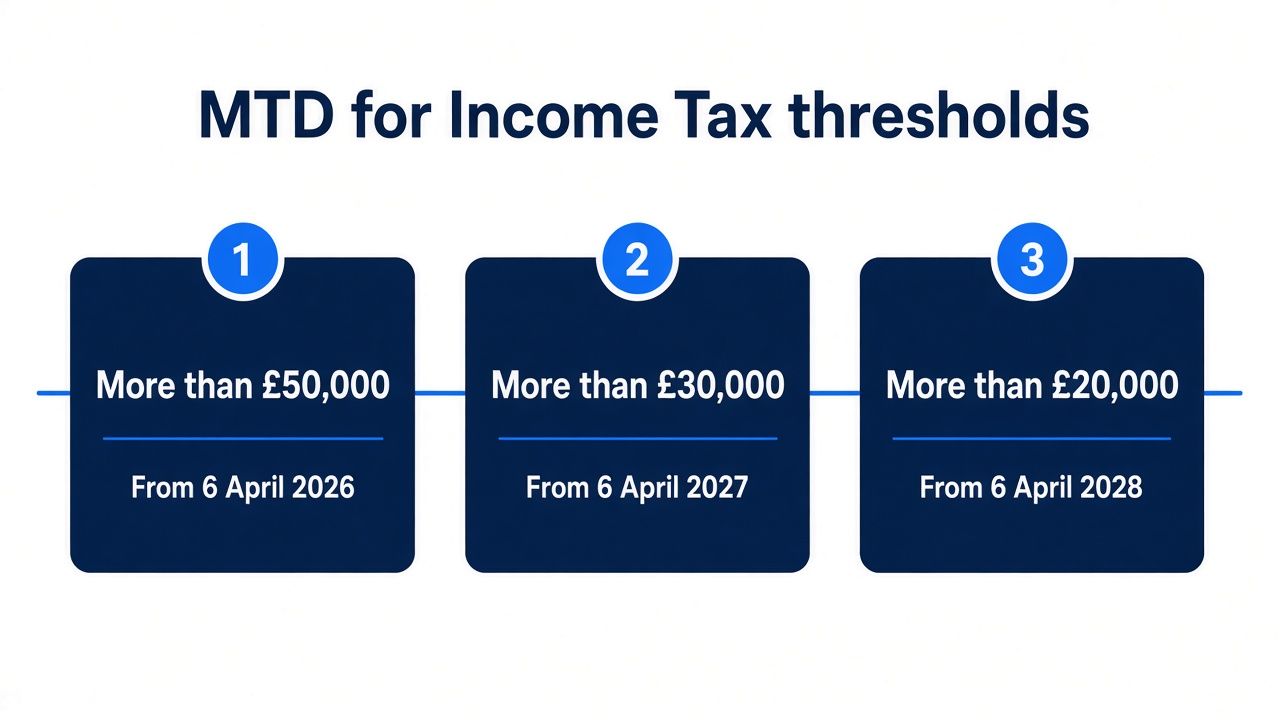
Thresholds and start dates
Self Assessment year | Qualifying income | Mandatory start
2024–25 | more than £50,000 | 6 April 2026
2025–26 | more than £30,000 | 6 April 2027
2026–27 | more than £20,000 | 6 April 202
| Qualifying income | Start date |
| More than £50,000 (2024–25) | 6 April 2026 |
| More than £30,000 (2025–26) | 6 April 2027 |
| More than £20,000 (202627) | 6 April 2028 |
From September 2026, HMRC begins automatically signing up anyone required for 2026–27 who has not already signed up, based on more than £50,000 qualifying income in 2024–25. If that happens, follow HMRC’s check what to do if signed up guidance.
Source: Find out if and when you need to use Making Tax Digital for Income Tax.
Qualifying income vs profit
Qualifying income is gross turnover from self-employment and property before expenses — not profit. That is the single point that catches the most people.
Counts toward qualifying income:
- Sole-trader / freelance turnover (gross)
- UK property rental income (gross)
- Foreign property income (if you are UK resident)
- Your share of jointly owned property
- Certain trust income paid direct; bare trust entitlements
- Disguised investment management fees / income-based carried interest
Does not count:
- PAYE employment salary
- Partnership profit share (as a partner)
- Dividends (including from your own company)
- State / private pensions
- Basis-period profits; REIT / PAIF income
- Qualifying care relief amounts; one-off UK land transactions (non-continuing)

If you use the cash basis and are VAT-registered, you can choose to include or exclude VAT when you declare your business income. Where VAT is included, it counts towards your MTD qualifying income.
Worked examples: qualifying income
Example A — turnover vs profit
Sam’s consultancy invoices £62,000 and has deductible expenses of 18,000. Taxable profit is £44,000. Qualifying income for MTD is £62,000. Sam is in for April 2026 if that relates to 2024–25.
Example B — trade + rent combined
Priya has £25,000 gross rent and £27,000 sole-trade turnover. Combined qualifying income is £52,000. She is in scope for April 2026 even though neither source alone exceeds £50,000.
Example C employed with a side hustle
Jordan earns 55,000 PAYE salary and £12,000 gross from weekend freelance work. Only the £12,000 counts. Jordan is not in the April 2026 wave on those figures.
Example D — director with a buy-to-let
Alex draws salary and dividends from their limited company and receives £28,000 gross rent personally. Company pay and dividends do not count. Only the £28,000 property income counts. Alex is not in for April 2026 on those figures, but would be in from April 2027 if 2025–26 qualifying income is more than £30,000.
Short first years and odd accounting periods can be annualised. HMRC may annualise sole-trader income where it has the data; property owners may need to annualise themselves. Check the GOV.UK page if your accounting period was not a clean 12 months.
Sole traders, landlords, and combined income
The same MTD for Income Tax regime applies to sole traders and landlords. Obligations apply per sole-trader business and per property business. In practice you send separate quarterly updates for each in-scope business (for example UK property and foreign property are treated separately).
Income from different sources is added together for the threshold test. That is why a modest rental portfolio plus a growing trade can push you over £50,000 even when each stream looks small on its own.
Partnerships and company directors: what’s out / what’s in
Partnerships are not currently mandated for MTD for Income Tax. The start date is still to be confirmed. Partnership profit share does not create an MTD obligation and does not count toward qualifying income. Partners who also have a separate sole trade or personal property income can still be mandated for that income.
Limited companies are not brought into MTD for Income Tax by the CT600. MTD for Income Tax is about income tax on a trade or property in your own name. A director with a personal buy-to-let or a side sole trade can be in even when the company is not.
Directors comparing salary and dividends for company extractions should read our companion note: Salary vs Dividends 2026/27.
Key dates for the 2026–27 tax year
If you are in the first wave, digital records start from 6 April 2026 (standard tax-year periods) or 1 April 2026 (calendar-aligned periods). Quarterly update deadlines for 2026–27 are the same either way:
Deadline
Digital records from | 6 Apr 2026 (standard) / 1 Apr 2026 (calendar)
- Q1 update | 7 Aug 2026
- Q2 update | 7 Nov 2026
- Q3 update | 7 Feb 2027
- Q4 update | 7 May 2027
- Tax return and pay | 31 Jan 2028
You still file your 2025–26 Self Assessment return in the usual way by 31 January 2027. That pre-MTD year is not replaced by quarterly updates.
| Period | Deadline |
| Digital records from | 6 Apr 2026 (standard) / 1 Apr 2026 (calendar) |
| Q1 update | 7 Aug 2026 |
| Q2 update | 7 Nov 2026 |
| Q3 update | 7 Feb 2027 |
| Q4 update | 7 May 2027 |
| Tax return and pay | 31 Jan 2028 |
Deadline
Diary 7 August 2026 for the first quarterly update if you are in the April 2026 wave — even with the soft landing.
Sources: Before you use this guide; HMRC news on the first quarterly deadline.
Prefer us to map your 2024–25 return to the threshold and software path? Get a quote or call 020 3576 5278.
Digital records
From the start date you need digital records for each in-scope business. As a minimum each entry needs an amount, a date, and a category that maps to Self Assessment categories. Compatible software creates, stores and corrects those records. Paper notebooks and year-end reconstructions are not enough once you are mandated.
Quarterly updates (what they are and aren't)
Each quarter you (or your agent) send HMRC a summary of income and expense totals for that period through the software. That is it.
They are not:
- A full tax return
- A demand for tax each quarter
- A substitute for your January payment
HMRC has consulted on possible future “timely payments” ideas. Those are not current law. Do not budget as if quarterly tax bills start with MTD for Income Tax in 2026–27 unless and until legislation changes.
Year-end tax return via software
After the fourth quarterly update you still complete a year-end tax return through compatible software. That return picks up other income, reliefs and allowances, and is where you finalise the position and pay by 31 January following the tax year (31 January 2028 for 2026–27). Use HMRCs wording: tax return via software — not a separate informal “end of period statement” process invented by secondary blogs.
Step-by-step collection: Making Tax Digital for Income Tax for businesses.
Software: choosing compatible tools (all-in-one vs bridging)
HMRC does not supply MTD for Income Tax software. You need a product that can:
- Create and store digital records
- Send quarterly updates
- Submit the year-end tax return, including other income, reliefs and allowances
Two common routes:
1. All-in-one — bookkeeping and MTD submissions in one product, typical for freelancers already on cloud accounting or landlords who want everything in one place.
2. Spreadsheets + bridging software keep working in Excel or Google Sheets, then use HMRC-recognised bridging software to submit. Useful if your records are already spreadsheet-based and you do not want a full accounting suite yet.
Use the official finder only: Find software that works with Making Tax Digital for Income Tax. Free and paid options exist. After sign-up you authorise the software to talk to HMRC.
If you already use an accountant or bookkeeper, ask how they want the file structured (main agent vs supporting agent) before you buy a second product that duplicates work.
Penalties and the 2026-27 soft landing
MTD for Income Tax uses a points-based late submission regime and proportionate late payment penalties for people in the regime. These replace the older personal Self Assessment late filing and late payment penalties for those obligations.
Soft landing for 2026-27
For the first mandated year (2026–27):
- There are no penalty points for late quarterly updates.
- You must still submit the quarterly updates before you file the year-end tax return.
- Penalty points do apply if the tax return itself is late.
The soft landing is breathing room while systems settle — not permission to skip Q1. From later years the points regime bites properly.
How points work (later years)
- 1 point per missed quarterly update or return deadline.
- Threshold of 4 points £200 penalty, then £200 for each further miss.
- Maximum one point per deadline, even if you have multiple businesses.
Late payment (high level)
Interest can run from day one that payment is late. Late payment penalties ramp by how late you are. In the first year there is a more lenient structure, including a 30-day period before penalties start, then percentage bands and a daily element — see the table on GOV.UK. Late payment penalties do not apply to payments on account, though interest still can.
Exemptions and when you can opt out
Some people are exempt automatically; others can apply. If you are exempt, continue normal Self Assessment and do not use MTD for Income Tax for that income.
Examples of automatic or permanent exemptions, unless circumstances change, include qualifying income of £20,000 or less, no National Insurance number before the start of the tax year, and certain entity filings such as some trust and personal representative returns.
There are also time-limited automatic deferrals into April 2027 for specific reliefs and return types shown on the 2024–25 return, for example averaging relief for farmers and creatives, qualifying care relief, and certain SA107 / SA109 cases.
You can apply for digital exclusion where age, disability, location or religious beliefs make digital impractical. HMRC will not accept as sole reasons: habit of paper returns, unfamiliarity with software, few transactions, or extra time and cost.
Once you are in the regime, you can opt out if qualifying income stays below the relevant threshold for three consecutive years.
Source: Find out if you can get an exemption from Making Tax Digital for Income Tax (updated 28 May 2026).
Landlord specifics (joint ownership & easements)

Joint landlords are assessed on their share of the property income for the qualifying-income test and for reporting. HMRC has published easements that can simplify quarterly reporting for some joint-ownership cases — for example reporting income in the quarters and dealing with expenses at year-end, or using summarised treatments where you are eligible.
Treat joint portfolios as a software-and-agent conversation, not a DIY guess:
1. Confirm your share of gross rents for the threshold test.
2. Check whether your chosen software supports the joint-ownership reporting options you need.
3. Read HMRC’s current use Making Tax Digital for Income Tax material and the step-by-step landlord collection.
4. Ask your accountant how expenses and year-end adjustments will be handled for each property.
Foreign property is treated as a separate property business from UK property for quarterly updates.
Practical joint-ownership detail can vary by software — confirm with your agent before the first quarter.
Practical checklist if you’re already in (or HMRC signed you up)
1. Confirm qualifying income from your 2024–25 return: gross self-employment plus property.
2. Sign up for Making Tax Digital for Income Tax if you have not already.
3. If HMRC auto-signed you up, follow the what to do next guidance.
4. Choose compatible software or bridging software and authorise it.
5. Map every income source: which are in MTD, which stay outside (PAYE, dividends, partnership share).
6. Get digital records live from 6 April 2026, or 1 April if calendar-aligned.
7. Diary the quarterly deadlines — especially 7 August 2026 for Q1.
8. Keep filing 2025–26 Self Assessment by 31 January 2027 as normal.
9. Plan the year-end software return and payment for 31 January 2028.
10. If Q1 is already late, still submit the updates before the year-end return; soft landing means no quarterly points in 2026–27, but you still need the data trail clean.
Preparing if you’re under £50,000 now but over £30,000 next
If 2024/25 qualifying income was £50,000 or less, you are not in the April 2026 mandatory cohort. Watch 2025–26. If qualifying income for that year is more than £30,000, you must start from 6 April 2027. The £20,000 threshold follows from 6 April 2028 based on 2026–27 income.
Use the spare year to:
- Clean categories in your bookkeeping so quarterly totals are trustworthy.
- Decide all-in-one vs bridging before you are under deadline pressure.
- Separate personal and property bank feeds if rents are mixed with salary.
- Check joint-ownership shares and tenancy paperwork now.
- Talk to your accountant about agent authorisation and who submits the quarters.
Voluntary early sign-up is available for some people who are not yet mandated — see HMRC’s sign-up guidance if you want systems tested before 2027.
Talk to Easey about MTD
Easey Accounts is an Essex-based ACCA / MAAT practice working with ambitious owner-managed businesses, sole traders and landlords across Essex, Kent, London and the wider UK. For clients who are in MTD for Income Tax, we file the quarterly updates and keep the year-end return aligned with the digital record — not as a separate January scramble.
If you want a clear view of whether you are in for 2026 or 2027, which sources count, and how software should sit with your existing books, start here:
Get a quote → https://tally.so/r/7RRjpA
Call: 020 3576 5278
We will work from your last return and your live records — not from a generic checklist.
FAQs
Do I need MTD if my profit is under 50,000 but turnover isn’t?
Yes, if gross qualifying income from self-employment and/or property is above the threshold. MTD looks at turnover before expenses, not profit.
Does rental income + freelance income get added together?
Yes. Gross rents and sole-trade turnover are combined for the qualifying-income test.
Are quarterly updates the same as a tax return? Do I pay tax?
No. Quarterly updates are income and expense totals only. They do not trigger payment. You still file a year-end tax return via software and pay by the January deadline.
What happens if I miss the 7 August 2026 deadline?
For 2026–27 there are no penalty points for late quarterly updates, but you must still submit the updates before the year-end return. Do not treat the soft landing as permission to skip Q1 — get the update in and fix the process.
Do partnerships or LLPs need MTD for Income Tax in 2026?
Partnerships are not currently mandated; the timeline is still to be confirmed. Partnership profit share does not count toward qualifying income. Separate sole-trade or personal property income can still bring a partner into MTD.
What software does HMRC recommend? Is free software available?
HMRC does not recommend a single product. It publishes a finder of compatible software. Free and paid options are listed there.
DOES MTD APPLY IF I’M EMPLOYED WITH A SIDE HUSTLE?
Only the self-employment and/or property gross income counts. PAYE salary does not. If the side hustle, plus any property, is above the threshold for the relevant year, that income is in scope.
HOW DO JOINT LANDLORDS REPORT?
Each owner is assessed on their share. Easements can simplify some quarterly reporting. Check GOV.UK’s MTD Income Tax guidance and confirm your software and agent can handle the joint-ownership options you need.
When does the £30,000 / £20,000 threshold hit?

More than £30,000 qualifying income in 2025–26 means start 6 April 2027. More than £20,000 in 2026–27 means start 6 April 2028.
Will HMRC sign me up automatically?
From September 2026, HMRC begins signing up anyone required for 2026–27 who has not already signed up, based on more than £50,000 qualifying income in 2024–25. Follow HMRC’s auto sign-up guidance if you receive notice.
What’s the difference between MTD for VAT and MTD for Income Tax?
MTD for VAT already applies to VAT-registered businesses and covers VAT returns. MTD for Income Tax is about Self Assessment for sole traders and landlords: digital records, quarterly income and expense updates, and a year-end Income Tax return via software. Being in one does not automatically put you in the other.
Sources
Last reviewed: 10 September 2026
Author: Easey Accounts (ACCA / MAAT practice)
- Making Tax Digital for Income Tax (collection)
- Find out if and when you need to use Making Tax Digital for Income Tax
- Work out your qualifying income
- Before you use this guide
- Step-by-step for businesses
- Find compatible software
- Penalties
- Exemptionss
- Sign up
- If HMRC has signed you up
- HMRC videos and webinars
This article is general information for the tax year, not personalised tax advice. Partnership mandation timing remains unset; any future quarterly payment timing is consultation territory, not a current obligation.
Related insights
Salary vs Dividends 2026/27: What’s the Most Tax-Efficient Way to Pay Yourself as a Company Director? — Tax · Read article
Further Tax and Property notes as published on Insights.
Talk to Easey about your numbers
We can map your last return and live records to the MTD threshold, deadlines and software path.
Get a quote → https://tally.so/r/7RRjpA
Call 020 3576 5278